- WordPress powers 42% of all websites globally with 2,927 multisite customers in East Africa
- Multisite reduces hosting costs by 60-80% for businesses managing multiple branch locations
- 90% of WordPress vulnerabilities stem from plugins affecting all sites in multisite networks
- New Azure cloud region in Olkaria will reduce latency for Kenyan businesses significantly
WordPress Multisite enables Kenyan businesses to manage multiple websites from a single installation, reducing costs and complexity for organizations with branches, franchises, or multiple brands. With 2,927 active multisite customers across East Africa and WordPress powering 42% of all websites globally, this powerful tool offers significant advantages for growing businesses.
Understanding WordPress Multisite for Kenyan Businesses
WordPress Multisite transforms a standard WordPress installation into a network capable of hosting multiple websites. Each site maintains its own content, users, and customization while sharing core files, plugins, and themes across the network.
Source: BuiltWith regional analysis and W3Techs data
Key Benefits for East African Organizations
The technology particularly suits businesses common in Kenya's market:
Multi-branch operations like Equity Bank, Safaricom retail outlets, or Nakumatt-style chains can create location-specific landing pages while maintaining brand consistency across all sites.
Educational institutions including University of Nairobi campuses, TVET colleges, or private school networks can give each department or campus its own web presence under unified management.
Media organizations can separate content vertically - news, sports, business sections - or create language-specific sites for English, Kiswahili, and regional languages.
Government entities at county level can maintain separate sites for different departments while ensuring consistent information architecture and security standards.
Technical Requirements and Setup Process
Hosting Infrastructure Needs
WordPress Multisite demands more robust hosting than standard WordPress sites. Here are the minimum requirements:
| Resource | Minimum | Recommended |
|---|---|---|
| RAM | 2GB | 4GB+ |
| PHP Version | 8.0+ | 8.1+ |
| MySQL | 5.7+ | 8.0+ |
| Storage | 10GB | 50GB+ |
| Bandwidth | 100GB | Unlimited |
Shared Hosting Limitations
Domain and SSL Configuration
Setting up domains requires careful planning. You have two primary options:
Subdomain structure (recommended for most Kenyan businesses):
- main-site.com
- nairobi.main-site.com
- mombasa.main-site.com
- kisumu.main-site.com
Subdirectory structure:
- main-site.com
- main-site.com/nairobi
- main-site.com/mombasa
- main-site.com/kisumu
Subdomains work better for geographically distributed businesses as they provide cleaner separation and better SEO for location-specific content.
Step-by-Step Setup Guide.
wordpress multisite hosting setup guide for kenyan businesses 1
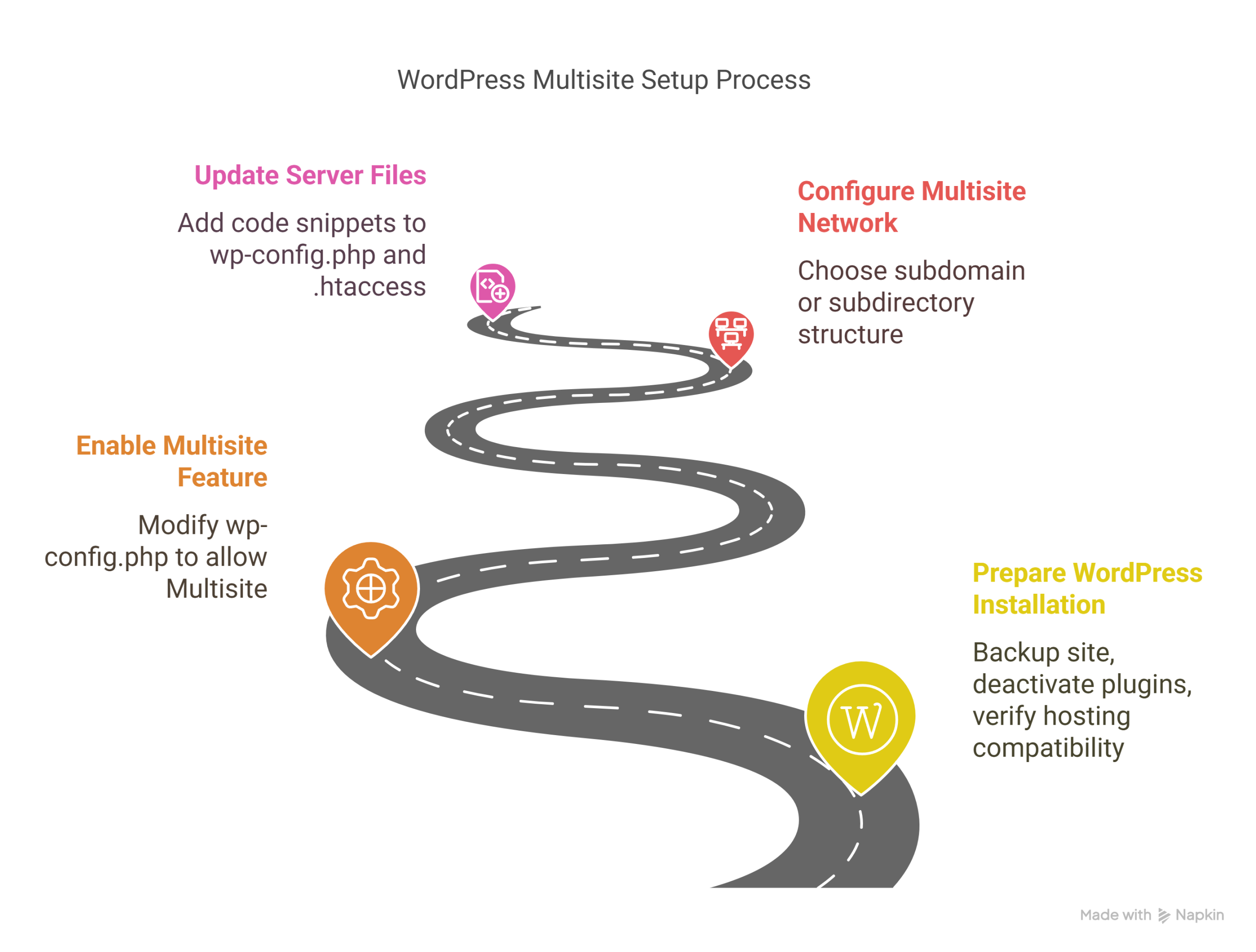
1. Enable Multisite in WordPress
Add this line to your wp-config.php file before the "That's all, stop editing" comment:
define('WP_ALLOW_MULTISITE', true);
2. Install Network Setup
Access Tools → Network Setup in your WordPress admin. Choose between subdomains or subdirectories based on your business structure.
3. Update Configuration Files
WordPress generates specific code for your wp-config.php and .htaccess files. Copy these exactly as provided.
4. Configure Wildcard SSL
For subdomain networks, install a wildcard SSL certificate (*.yourdomain.com) to secure all current and future subsites automatically.
Ready to Launch Your WordPress Multisite Network?
Get enterprise-grade WordPress hosting with multisite support, M-Pesa billing, and 24/7 Nairobi-based support in English and Kiswahili.
Managing Multisite Networks Effectively
User Management and Permissions
WordPress Multisite introduces network-level user roles beyond standard WordPress permissions:
Super Admin: Controls the entire network, can create/delete sites, install plugins network-wide, and manage all users across all sites.
Site Admin: Manages individual sites within the network, similar to standard WordPress admin but cannot install plugins unless permitted by Super Admin.
Network-wide roles: Users can have different permission levels across different sites in the network.
Plugin and Theme Management
Network administrators control which plugins and themes are available to individual site administrators. This centralized approach ensures:
- Consistent security standards across all sites
- Brand compliance through approved theme selections
- Reduced maintenance overhead through standardized plugin sets
- Cost savings by purchasing premium plugins once for network-wide use
Performance Optimization Strategies
WordPress Multisite networks require specific optimization approaches:
Database optimization becomes critical as all sites share the same database with prefixed tables. Regular cleanup of spam, revisions, and unused data prevents performance degradation.
Caching strategies must account for multiple sites. Network-wide caching solutions like Redis or Memcached work better than individual site caching plugins.
Content Delivery Networks (CDN) provide significant benefits given Kenya's mobile-heavy internet usage. With 53% of mobile users abandoning sites taking over 3 seconds to load, proper CDN setup is essential for user retention.
Security Considerations for East African Businesses
Plugin Vulnerability Management
Security represents the biggest challenge in WordPress Multisite networks. Approximately 90% of WordPress vulnerabilities originate from plugins, and in multisite networks, a single vulnerable plugin affects every site in the network.
Security Best Practices
Backup and Disaster Recovery
Traditional WordPress backup solutions often struggle with multisite networks. Enterprise-grade backup systems must handle:
- Network-wide database backups including all site-specific tables
- Individual site file uploads and customizations
- Network configuration and .htaccess rules
- Regular testing of backup restoration procedures
Compliance with Kenyan Data Protection
Under Kenya's Data Protection Act, businesses processing personal data must implement appropriate technical and organizational measures. Multisite networks require:
- Audit trails showing which administrator accessed which site
- Data retention policies applied consistently across all network sites
- User consent management systems that work network-wide
- Regular security assessments covering the entire network infrastructure
Cost Analysis and ROI for Kenyan Businesses
Hosting Cost Comparisons
The global WordPress hosting market, valued at $15 billion in 2025 with 12% annual growth, offers various pricing models:
| Hosting Type | Global Range | Kenyan Market | Best for Multisite |
|---|---|---|---|
| Shared | $2-10/month | KES 500-2,000 | Not recommended |
| WordPress | $3-25/month | KES 800-5,000 | Small networks |
| VPS | $10-100/month | KES 2,500-20,000 | Medium networks |
| Cloud | $10-200/month | KES 2,500-40,000 | Large networks |
ROI Calculations
A typical Kenyan business managing 5 separate WordPress sites would spend approximately KES 15,000-25,000 monthly on individual hosting accounts. Consolidating to a properly configured multisite network reduces this to KES 5,000-8,000 monthly - a 60-80% cost reduction.
Additional savings include:
- Plugin licensing: Purchase premium plugins once instead of per-site
- Maintenance time: Update themes and plugins across all sites simultaneously
- Security monitoring: Monitor one network instead of multiple independent sites
- Backup storage: Network-wide backups vs. individual site backups
Regional Infrastructure Developments
Upcoming Cloud Infrastructure
Microsoft and G42's $1 billion investment in East African digital infrastructure includes a major data center campus at Olkaria, Kenya. This Azure-compatible cloud region, expected within 24 months, will significantly reduce latency for Kenyan businesses currently experiencing 150-250ms delays from US/European servers.
The Olkaria facility will particularly benefit WordPress Multisite networks by providing:
- Sub-50ms latency to Nairobi-based users
- Improved mobile performance for Kenya's smartphone-heavy internet usage
- Better compliance with local data residency requirements
- Reduced bandwidth costs for businesses serving primarily East African audiences
Future-Proofing Your Network
Common Pitfalls and How to Avoid Them
Technical Challenges
Domain mapping issues frequently occur when businesses want to use completely different domain names for network sites (e.g., mainbusiness.com, subsidiary.co.africa). While possible, this requires additional configuration and often premium plugins.
Plugin conflicts multiply in multisite environments. A plugin that works perfectly on a single site might cause network-wide issues when activated across multiple sites with different configurations.
Database bloat accumulates faster in multisite networks. Without regular maintenance, shared databases can slow down all sites in the network.
Business Process Issues
User training becomes more complex as administrators need to understand network-level vs. site-level permissions. Many Kenyan SMEs underestimate the learning curve for staff managing multisite networks.
Content governance requires clear policies about which content appears on which sites, especially for businesses serving different geographic markets with varying cultural considerations.
Alternatives to Consider
When Multisite Isn't the Right Choice
Some business scenarios work better with alternative approaches:
Completely different business models (e.g., e-commerce + blogging + portfolio) often need different plugins and themes that conflict in multisite networks.
Limited technical resources make multisite risky. If your business relies on one freelancer or small agency for website management, managing multiple domains on a single web hosting account through separate installations might be safer.
High-traffic sites might perform better as separate, optimized installations rather than competing for resources in a shared multisite environment.
WordPress Multisite offers powerful solutions for Kenyan businesses managing multiple web properties, from SACCO branch networks to university campuses. While setup requires technical expertise and ongoing security vigilance, the cost savings and management efficiency make it attractive for growing organizations.
As Kenya's digital infrastructure improves with developments like the Olkaria data center, multisite networks will become even more viable for businesses serving East African markets. Tayo Host provides WordPress multisite hosting with M-Pesa billing integration, Nairobi-based support in multiple languages, and the technical expertise to help Kenyan businesses maximize their multisite investment.