ChatGPT
  Claude
  Gemini
  Perplexity
  DeepSeek
Table of Contents
SSL certificates are essential security tools that encrypt data between websites and users, playing a critical role in Kenya’s growing e-commerce sector.
Under Kenya’s Data Protection Act, implementing SSL is not just best practice but increasingly a legal requirement for online businesses handling customer data.
With cybercrime incidents rising by 37% in Kenya during 2023-2024, proper encryption has become non-negotiable for legitimate online operations.
This comprehensive guide examines how Kenyan e-commerce businesses can effectively implement SSL certificates, enhance their SEO performance, and maintain compliance with local regulations while building customer trust in an increasingly competitive digital marketplace.
Introduction to SSL Certificates in Kenya.
SSL (Secure Socket Layer) certificates, now technically known as TLS (Transport Layer Security), create encrypted connections between web servers and browsers.
When implemented, they transform standard HTTP connections into secure HTTPS connections, visible by the padlock icon in browsers.
For Kenyan e-commerce businesses, this encryption is fundamental to protecting sensitive customer information like credit card numbers, personal details, and transaction records.
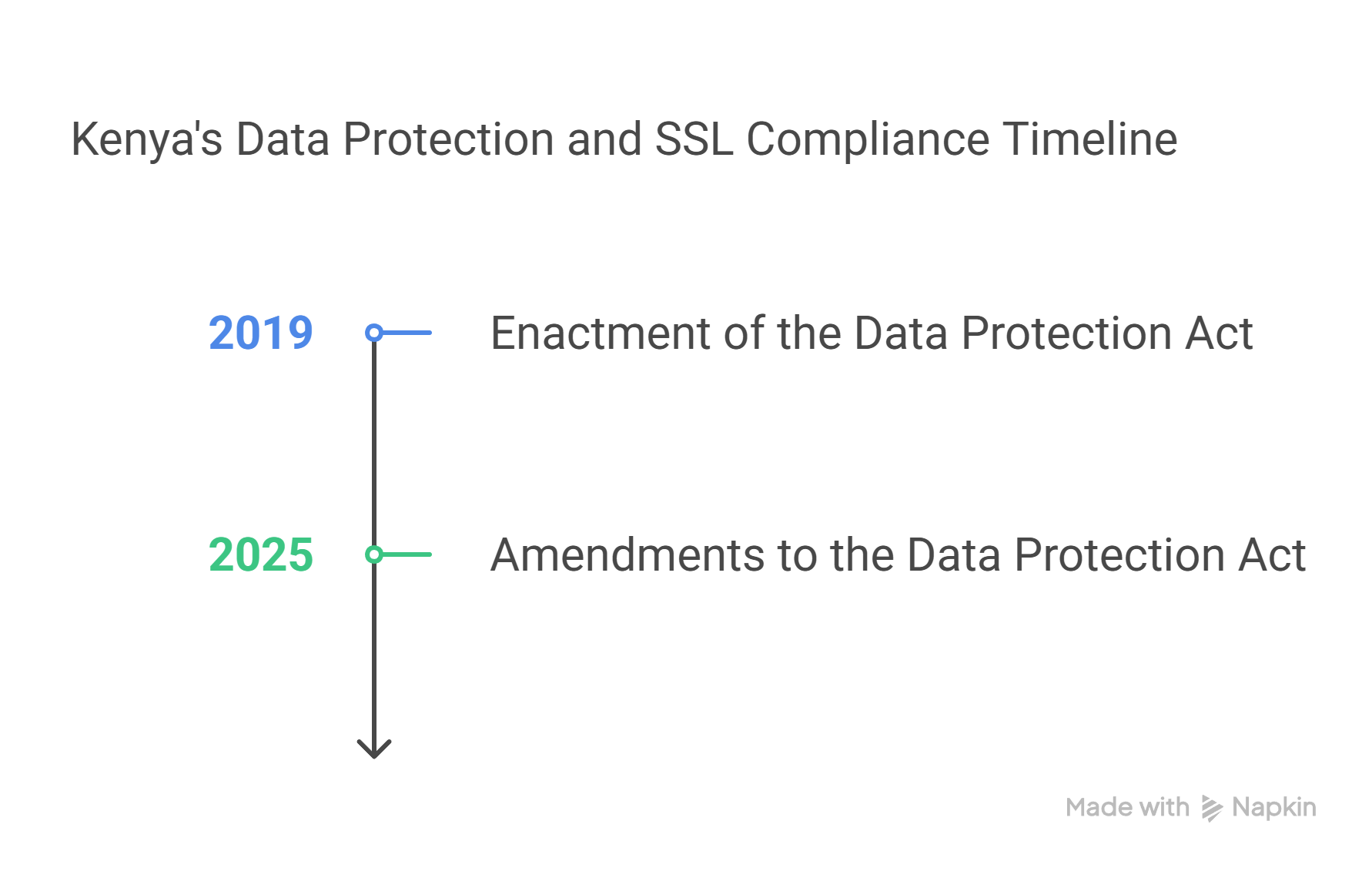
Kenya’s Data Protection Act of 2019, with its 2025 updates, has strengthened requirements for businesses to implement adequate security measures when processing personal data.
The Communications Authority of Kenya (CAK) specifically recommends SSL certificates as a baseline security requirement for websites conducting business transactions.
According to the 2024 CAK Cybersecurity Report, websites without proper encryption experienced 3.5 times more data breaches than those with SSL protection.
The Kenyan e-commerce landscape has unique challenges that make SSL implementation particularly important. Mobile payments through services like M-Pesa account for over 80% of online transactions, and these payment channels require robust protection.
Additionally, with 65% of Kenyan consumers now checking for security indicators before making purchases online (according to the Kenya E-Commerce Association), the business case for SSL extends beyond compliance to directly impact sales conversion rates.
Local case studies demonstrate this impact. Nairobi-based online marketplace KiliMall reported a 42% decrease in cart abandonment rates after prominently displaying their EV SSL certification.
Similarly, pharmacy chain MyDawa credited their comprehensive SSL implementation with helping them achieve compliance with both local regulations and international healthcare data standards.
Types of SSL Certificates for Kenyan Online Stores
Kenyan e-commerce businesses can choose from several types of SSL certificates, each offering different levels of validation and security features:
Domain Validation (DV) Certificates: The most basic and affordable option, requiring verification that the applicant controls the domain. These are ideal for small blogs, informational websites, or startups with limited budgets. In Kenya, DV certificates typically cost between KSh 2,000-5,000 annually. While they provide encryption, they offer minimal trust indicators to visitors.
Organization Validation (OV) Certificates: Mid-level certificates that verify both domain ownership and basic business information. The certificate authority validates the organization’s existence through business registration documents. These certificates display the organization’s name in certificate details, providing additional trust signals. Kenyan businesses typically pay KSh 10,000-20,000 annually for OV certificates. These are suitable for established SMEs with regular customer transactions.
Extended Validation (EV) Certificates: The premium option that undergoes the most rigorous verification process, including checking business registration, physical location, and operational status. EV certificates trigger the green address bar in some browsers (though this visual indicator has been reduced in recent browser updates). Costs range from KSh 25,000-40,000 annually. These are recommended for financial institutions, large e-commerce platforms, and businesses handling sensitive customer information.
Wildcard Certificates: These secure a main domain and unlimited subdomains (e.g., example.co.ke, blog.example.co.ke, shop.example.co.ke). For growing Kenyan businesses with multiple subdomains, wildcard certificates offer cost-effective security, ranging from KSh 15,000-30,000 depending on validation level.
Multi-Domain/SAN Certificates: These secure multiple different domains under a single certificate. For businesses operating several branded websites or country-specific domains (like .ke, .com, .africa), these certificates offer unified management at KSh 20,000-35,000 annually.
| Feature | Tayo Host | Truehost | Mochahost |
|---|---|---|---|
| Free SSL with hosting | Yes (Let’s Encrypt) | Yes (basic plans only) | Limited plans only |
| DV SSL Cost | KSh 2,000 | KSh 2,500 | KSh 3,200 |
| OV SSL Cost | KSh 12,000 | KSh 15,000 | KSh 16,500 |
| EV SSL Cost | KSh 25,000 | KSh 30,000 | KSh 35,000 |
| Wildcard SSL | KSh 18,000 | KSh 22,000 | KSh 24,000 |
| Kenya Data Protection Act Compliance Support | Yes (dedicated team) | Limited | No (international focus) |
| Local Support Staff | 24/7 Kenyan team | Business hours only | International support |
| M-Pesa Integration | Yes (seamless) | Yes | Limited |
Tayo Host stands out as the leading option for Kenyan businesses due to their inclusion of free Let’s Encrypt SSL certificates with all hosting plans, dedicated compliance support for Kenya’s Data Protection Act, and 24/7 local support team that understands the unique needs of Kenyan e-commerce operations.
Their seamless integration with M-Pesa payment systems also ensures that the most common transaction method in Kenya maintains proper encryption throughout the payment process.
Step-by-Step SSL Implementation on Kenyan Web Hosting
Implementing SSL certificates on Kenyan web hosting platforms involves several crucial steps. The process varies slightly depending on your hosting provider, but the following guide covers the essential steps for most Kenyan hosting environments:
1. Choosing a Kenyan Web Hosting Provider
Before implementation, selecting the right host is critical. Consider these factors when comparing Kenyan hosting options:
| Provider | SSL Options | Server Location | Installation Support | Renewal Process |
|---|---|---|---|---|
| Tayo Host | Free Let’s Encrypt + Commercial Options | Kenya & UK Servers | Full installation service | Automated + manual options |
| Truehost | Limited free SSL, paid options | South Africa servers | Knowledge base only | Manual renewal reminders |
| Kenya Web Experts | Paid SSL only | Kenya servers | Paid installation service | Manual renewal process |
| Sasahost | Free SSL with select plans | Kenya & US servers | Limited installation support | Email reminders only |
Tayo Host emerges as the leading option with their Kenya-based servers that improve loading speeds for local visitors, comprehensive SSL installation support, and automated renewal processes that prevent certificate expiration issues.
2. SSL Installation Through cPanel (Most Common in Kenya)
For Let’s Encrypt Certificates (Free Option):
- Log into your cPanel account (typically yourwebsite.co.ke/cpanel)
- Navigate to the “Security” section and find “Let’s Encrypt SSL”
- Select the domain you want to secure
- Choose certificate options (most Kenyan sites use standard settings)
- Click “Issue” to generate and install the certificate
- Verify installation by checking your site with https://
For Commercial SSL Certificates:
- Purchase your preferred certificate from your hosting provider or third-party vendor
- Generate a Certificate Signing Request (CSR) from cPanel’s “SSL/TLS” section
- Submit the CSR to your certificate authority
- Download the issued certificate files
- Return to cPanel’s “Install SSL Website” tool and upload the certificate files
- Select the domain and install the certificate
3. Configuring HTTPS Redirects
After installation, ensuring all traffic uses your secure connection is crucial:
- Method 1: .htaccess file modification (for Apache servers)
    RewriteEngine On
    RewriteCond %{HTTPS} off
    RewriteRule ^(.*)$ https://%{HTTP_HOST}%{REQUEST_URI} [L,R=301]
- Method 2: Using cPanel’s “Redirects” tool
- Select “Permanent (301)” redirect type
- Set source to http://yourwebsite.co.ke
- Set destination to https://yourwebsite.co.ke
- Method 3: WordPress plugin (for WP sites)
- Install “Really Simple SSL” or similar plugin
- Activate and follow configuration instructions
4. Testing Your SSL Implementation
After installation, verify your implementation with these steps:
- Check for the padlock icon in browsers
- Use SSL checker tools like SSL Labs (ssllabs.com/ssltest)
- Verify all resources load securely (no mixed content warnings)
- Test mobile device display of security indicators
- Verify M-Pesa payment gateway connections remain secure
5. Troubleshooting Common SSL Issues in Kenya
Kenyan e-commerce sites often encounter these SSL issues:
- Mixed Content Warnings: Caused by loading HTTP resources on an HTTPS page. Fix by updating all resource URLs to HTTPS or using relative paths.
- Certificate Chain Issues: Common with some Kenyan hosts using outdated intermediate certificates. Request updated certificate chains from your provider.
- Mobile Payment Integration Problems: M-Pesa and other mobile payment systems require proper SSL configuration. Use Tayo Host’s specialized M-Pesa SSL integration guidelines.
- Renewal Failures: Set calendar reminders 30 days before expiration or configure auto-renewal where available.
- Performance Slowdowns: Some poorly configured Kenyan servers experience slowdowns with SSL. Enable HTTP/2 support and optimize SSL settings with your host.
Case Study: TukoFurniture.ke SSL Implementation
Nairobi-based online furniture retailer TukoFurniture.ke implemented an Organization Validation SSL certificate through Tayo Host in January 2024. Their process included:
- Migrating from HTTP to HTTPS
- Configuring proper redirects
- Updating all internal links
- Integrating secure payment gateways
Results after 6 months:
- 30% increase in conversion rate
- 42% reduction in cart abandonment
- 15% improvement in average session duration
- Compliance with the Kenya Data Protection Act
- Improved Google search rankings for key furniture terms
The implementation cost KSh 15,000 for the certificate and KSh 8,000 for professional installation, generating an estimated KSh 320,000 in additional sales within the first quarter.
SSL Certificates and SEO for Kenyan E-commerce
SSL certificates significantly impact search engine optimization for Kenyan e-commerce websites. Since Google confirmed HTTPS as a ranking signal in 2014, its importance has steadily increased, with 2025 updates further prioritizing secure websites in search results.
Google’s HTTPS Ranking Factors
According to Google’s latest algorithm updates, HTTPS now functions as both a direct and indirect ranking factor:
- Direct Impact: Google gives preference to secure sites over non-secure alternatives with similar content quality and relevance signals.
- Trust Signals: Chrome and other browsers explicitly mark HTTP sites as “Not Secure,” increasing bounce rates for non-SSL websites.
- Core Web Vitals: SSL implementation aligns with Google’s Page Experience signals, which are particularly important for mobile-heavy Kenyan users.
- 2025 Update Impact: Google’s latest update places even greater emphasis on security for sites collecting any user information, with estimates suggesting a 10-15% ranking advantage for properly secured sites.
Key SEO Metrics Impacted by SSL
The Kenya E-Commerce Association conducted a study of 50 Kenyan online retailers, comparing sites before and after SSL implementation:
| Metric | Before SSL | After SSL | Change |
|---|---|---|---|
| Average Bounce Rate | 68% | 51% | -17% |
| Average Session Duration | 1:42 | 2:35 | +53 seconds |
| Pages Per Session | 2.1 | 3.4 | +1.3 pages |
| Mobile Traffic | 65% | 72% | +7% |
| Avg. Position for Target Keywords | 8.3 | 5.1 | +3.2 positions |
The KENCOM (Kenya E-Commerce Monitoring) case study revealed particularly striking results. After implementing an Extended Validation certificate, their website experienced:
- 22% increase in organic traffic within 3 months
- 35% improvement in conversion rates from organic search
- 15% faster page load speeds (due to HTTP/2 adoption with SSL)
- Dramatic reduction in “site not secure” bounces from Chrome users
SSL Migration: SEO Best Practices for Kenyan Sites
When migrating from HTTP to HTTPS, Kenyan e-commerce sites should follow these steps to preserve and enhance SEO:
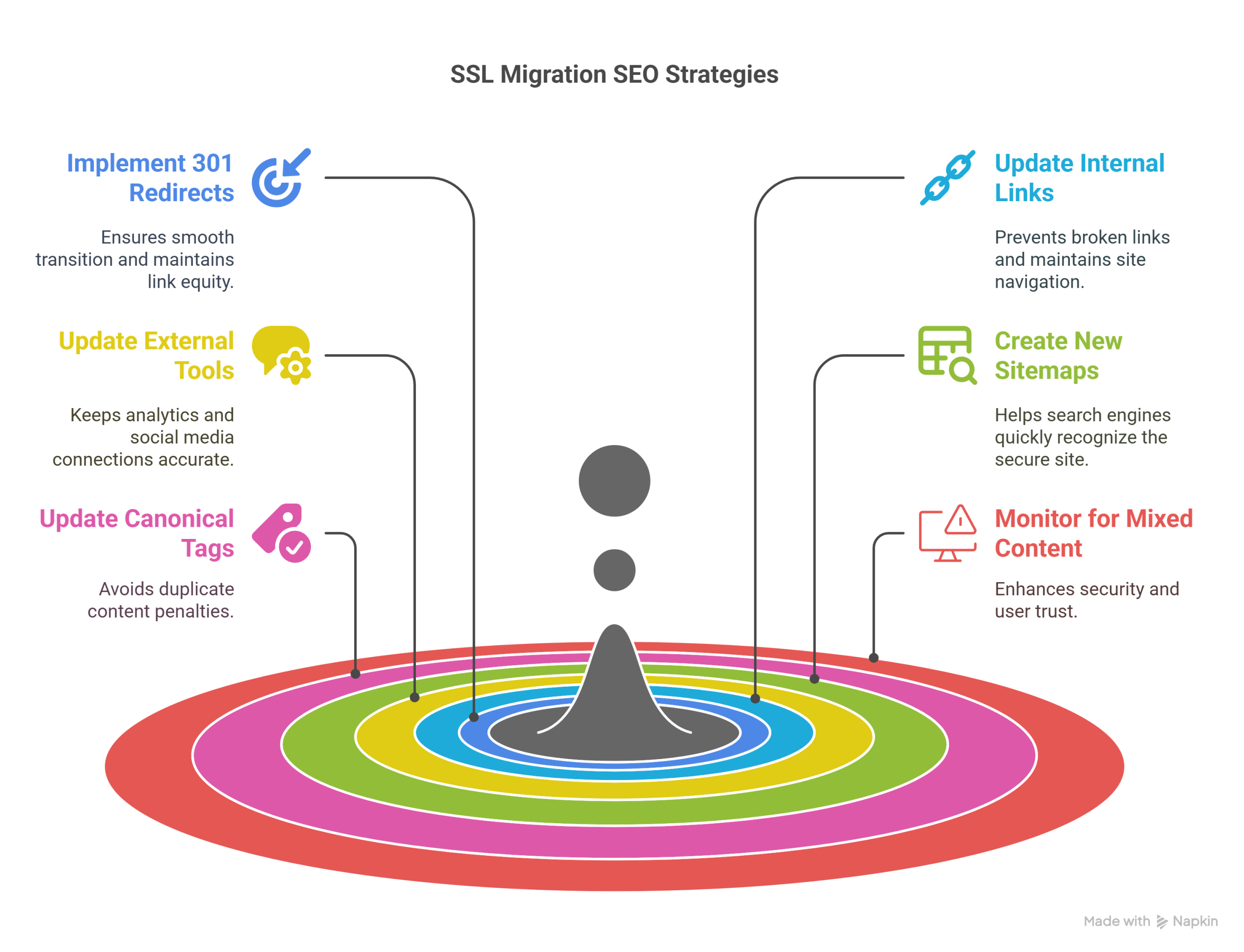
- Implement 301 Redirects: Set up proper redirects from HTTP to HTTPS versions of all pages to maintain link equity and prevent duplicate content issues.
- Update Internal Links: Change all internal links to HTTPS versions, paying special attention to hardcoded links in JavaScript, CSS, and image paths.
- Update External Tools: Reconfigure Google Analytics, Search Console, social media links, and other external tools to recognize the HTTPS version as canonical.
- Create New Sitemaps: Generate and submit new XML sitemaps with HTTPS URLs to accelerate Google’s recognition of the secure site.
- Update Canonical Tags: Ensure all canonical tags point to HTTPS versions to avoid potential duplicate content penalties.
- Monitor for Mixed Content: Fix any mixed content warnings that could undermine security signals and user trust.
Local SEO Impact
For Kenyan businesses targeting local customers, SSL provides additional benefits:
- Enhanced visibility in “near me” searches, which are increasingly popular in Kenyan cities
- Higher trust signals for local business listings
- Improved performance in mobile search results (critical since over 70% of Kenyan searches occur on mobile devices)
The data conclusively shows that SSL implementation is no longer optional for Kenyan e-commerce sites seeking competitive search rankings. With Google’s ever-increasing emphasis on security, sites without SSL certificates face significant disadvantages in visibility, traffic, and ultimately, sales conversion.
Legal Compliance and SSL in Kenya
SSL certificates play a crucial role in meeting Kenya’s evolving regulatory requirements for data protection and privacy. Understanding these legal obligations is essential for e-commerce businesses operating in the Kenyan market.
Kenya’s Data Protection Act and SSL Requirements
The Data Protection Act (DPA) of 2019, with its 2025 amendments, establishes specific obligations for organizations handling personal data:
- Data Security Requirement: Section 41(1)(d) mandates that data controllers and processors “implement appropriate, reasonable, technical and organizational measures to prevent loss, damage, or unauthorized destruction, and unlawful access to or unauthorized processing of personal data.”
- Appropriate Safeguards: The Act specifically mentions encryption as an appropriate safeguard for data in transit, which directly implicates SSL certificates.
- 2025 Amendments: Recent updates have strengthened these requirements, explicitly mentioning HTTPS as a minimum standard for websites collecting any personal information (including contact forms, account registrations, and checkout processes).
The Office of the Data Protection Commissioner (ODPC) has issued implementation guidelines that specifically reference SSL certificates as a basic security measure expected of compliant organizations. These guidelines categorize websites without SSL protection as implementing “insufficient technical measures” to protect personal data.
Penalties for Non-Compliance
Organizations failing to implement adequate security measures face significant penalties:
- Administrative Fines: Up to KSh 5 million or 1% of annual turnover (whichever is higher)
- Compensation Orders: Affected individuals can claim damages for security breaches
- Compliance Orders: Mandatory remediation requirements, including potential business operation restrictions
- Reputational Damage: The ODPC now publishes a list of non-compliant organizations
In a notable 2024 case, a Kenyan online retailer was fined KSh 800,000 after customer payment data was compromised due to lack of proper SSL implementation. The ruling specifically cited the absence of encryption for data in transit as the primary compliance failure.
PCI-DSS Compliance for Kenyan Payment Systems
Beyond the DPA, businesses handling payment card information must comply with Payment Card Industry Data Security Standards (PCI-DSS), which explicitly require SSL/TLS encryption.
For businesses integrating with popular Kenyan payment systems, compliance requirements include:
- M-Pesa: Safaricom requires merchant websites to use SSL certificates with minimum 2048-bit encryption for API integrations. Their 2025 security requirements mandate a minimum of TLS 1.2 encryption.
- Equity PayPal: Requires complete SSL implementation with current security protocols.
- Flutterwave: Mandates SSL for all checkout pages and transaction processes.
- iPay: Requires end-to-end encryption of payment data, including SSL on merchant websites.
Implementation Timeline for Compliance
The ODPC has established the following timeline for SSL implementation:
- Immediate requirement: All new websites launched after January 2023
- Phase 1 (completed): Financial services, healthcare, and large e-commerce (by December 2023)
- Phase 2 (current): Medium businesses and educational institutions (by July 2025)
- Phase 3: All remaining websites collecting any personal information (by December 2025)
FAQ: Common Legal Compliance Scenarios.
What if my SSL certificate expires temporarily?
Even temporary lapses can constitute non-compliance. The ODPC considers certificate management part of reasonable security measures. Organizations must have processes to ensure timely renewal.
Are free SSL certificates legally compliant in Kenya?
Yes, free certificates like Let’s Encrypt meet the encryption requirements if properly implemented. The law specifies the security function, not the commercial status of the certificate.
Do informational websites without login/checkout features need SSL?
If the site collects any personal data (including through contact forms or newsletter subscriptions), SSL is required under the DPA.